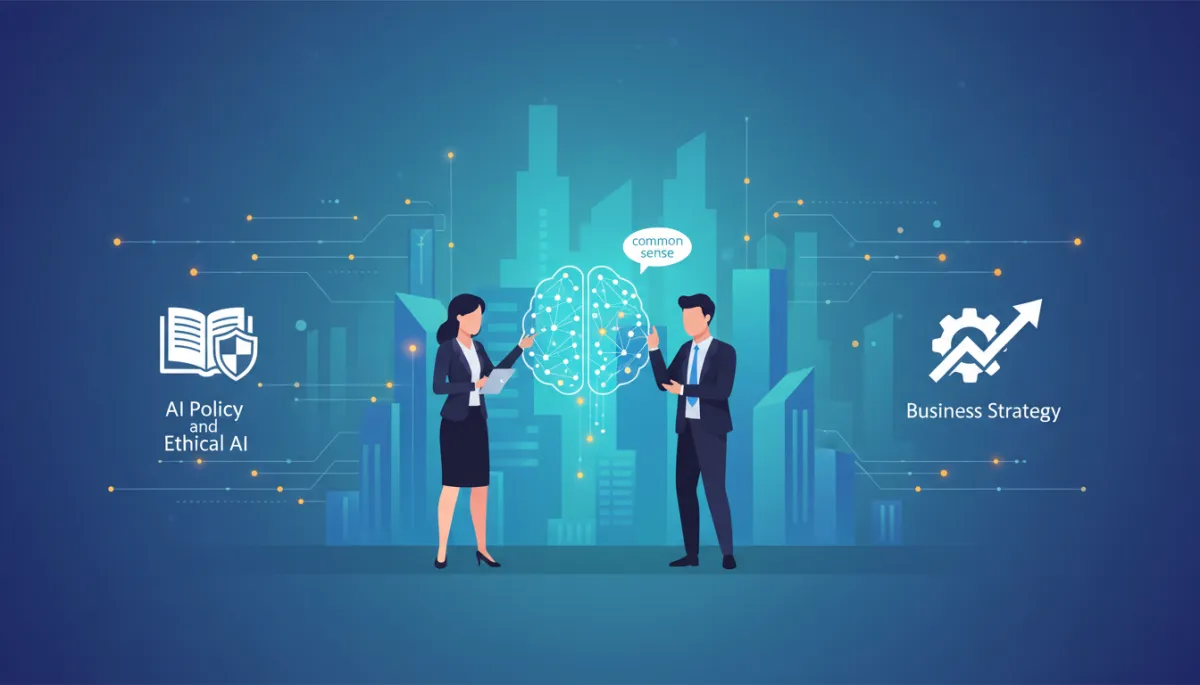
Common Sense AI: Strategy for Business Growth
AI Policy, Business Strategy, Ethical AI, Common Sense AI
Common Sense AI: Practical SEO and Governance for Growing Businesses
How a grounded, “common sense first” approach to AI Policy, Ethical AI, and AI Implementation can protect your business while still driving growth and better content.
Executive Overview: AI That Actually Makes Business Sense
If you run a small-to-mid-sized business or manage an MSP, you are probably being told two conflicting things about AI: “move fast or you’ll be left behind” and “be careful or you’ll get sued, hacked, or embarrassed.” Both are true—unless you bring common sense into your AI strategy from day one.
As an SEO Content Strategist and AI Governance advisor, my job is to help you use AI to create better content, win more organic traffic, and streamline operations—without ignoring risk, ethics, or regulation. That means aligning your AI Policy, Business Strategy, and day‑to‑day AI Implementation with recognized frameworks like the NIST AI Risk Management Framework (AI RMF) and ISO/IEC 42001, but in a way that is actually workable for a 20‑person company, not just a global bank (NIST, 2023; ISO/IEC, 2023).
This article walks through the business problem, real risks, practical recommendations, and clear action steps so you can build Common Sense AI into your marketing and operations—without needing a legal department the size of a football team.
Introduction: Where SEO Content Meets AI Governance
Most AI conversations treat content and governance as two separate worlds. On one side, marketers want AI to draft blog posts, landing pages, and email campaigns at scale. On the other, risk and compliance teams worry about data leaks, copyright problems, and biased outputs. In smaller organizations, those “teams” are often the same two or three people wearing multiple hats—sometimes that person is you.
A smarter path is to treat SEO, content, and AI Governance as one connected system. If you design content workflows that are Ethical AI by default—transparent, privacy‑respecting, and well‑documented—you not only reduce risk, you also build trust with customers and search engines. Google increasingly rewards high‑quality, accountable content, not just volume. That is where a “common sense first” mindset pays off quickly in both visibility and safety.
The Business Problem: Fast AI, Slow Governance
In 2026, AI tools are everywhere. Your writers use generative AI to outline articles, your support team experiments with chatbots, and your MSP clients ask about AI agents that can “just handle” tickets. Meanwhile, regulations like the EU AI Act are becoming enforceable, and U.S. states are rolling out their own AI laws (Ethicalogic, 2026; Presenc.ai, 2026). The result is a widening gap between AI adoption and AI readiness: many organizations embed AI into core processes long before they have a basic AI Policy in place (Forbes, 2026).
For small and mid‑sized businesses, the pain shows up in a few familiar ways:
Content inconsistency: AI‑generated pages don’t match your brand voice or make unverified claims, hurting SEO and credibility.
Shadow AI use: Staff quietly paste customer data into public tools without approval or logging.
Unclear accountability: If an AI‑driven recommendation is wrong, no one is sure who owns the decision or the fix.
None of this requires a PhD to solve. It requires structure, clarity, and a bit of common sense baked into your Business Strategy and content workflows.
The Real Risks: Beyond Buzzwords and Headlines
Headlines tend to focus on extreme AI failures, but the risks most SMBs and MSPs face are more practical and closer to home. The NIST AI Risk Management Framework breaks risk management into four functions—Govern, Map, Measure, and Manage—and highlights issues like bias, security, reliability, and documentation across the AI lifecycle (NIST, 2023). For generative AI specifically, NIST’s 2024 profile calls out content authenticity, data provenance, and misuse as key concerns (NIST, 2024).
Add to that the management‑system view of ISO/IEC 42001, which asks you to treat AI like any other serious business process: define scope, assign responsibilities, monitor performance, and continually improve (ISO/IEC, 2023). In 2026, more organizations are getting formally certified, especially in regulated sectors, to show they run Ethical AI in a controlled way (UKAS, 2026; NQA, 2026; CPSI, 2026).
For your business, the main risk categories usually look like this:
Reputational risk: AI‑generated content publishes inaccurate or biased claims under your logo, harming trust and SEO performance.
Data and privacy risk: Sensitive or client data is exposed through prompts, logs, or poorly configured tools.
Regulatory and contract risk: You fail to meet customer or regulatory expectations around transparency, human oversight, or record‑keeping.
Operational risk: Over‑reliance on AI agents leads to silent errors, especially in support, security, or financial workflows (TechRadar, 2026; KPMG, 2026).

Even a lightweight AI checklist dramatically reduces everyday content and data risks.
Recommendations: Common Sense AI for Real‑World Teams
The good news: you do not need to implement every clause of ISO/IEC 42001 or every profile of the NIST AI RMF to start being responsible. You can borrow the spirit of these frameworks and scale them to your size. Here is how a Common Sense AI approach typically looks for SMBs and MSPs.
Start with one clear use case. For example, “supporting SEO content ideation and first drafts” or “triaging low‑risk support tickets.” Map where data comes from, who reviews outputs, and what “good” looks like. This aligns with NIST’s Map function without overwhelming your team (NIST, 2023).
Write a short, plain‑language AI Policy. In two or three pages, explain what tools are allowed, what data can never go into them, who must review outputs, and how you log decisions. Think of it as a mini version of an ISO/IEC 42001 AI management system tailored to your size (ISO/IEC, 2023).
Keep a human in the loop where it matters. Surveys show most leaders now view human approval as their top AI governance control (Zapier, 2026). For content, that means a named person is accountable for fact‑checking and final edits before anything goes live.
Document enough to be believable, not perfect. Save prompts for key decisions, track which tools were used, and keep a simple log of issues and fixes. This creates an audit trail without turning your team into full‑time auditors.
Align AI with your brand and SEO strategy. Use AI to support keyword research, outlines, and drafts, but lock in your brand voice, claims, and calls‑to‑action through clear content guidelines. AI supports your Business Strategy; it does not define it.
💡 Common Sense AI Tip: If you would not say it to a customer or regulator face‑to‑face, do not let your AI system say it on your behalf.
Action Steps: A 30–60 Day Plan for SMBs and MSPs
To make this concrete, here is a simple roadmap you can follow over the next one to two months. Adjust timelines based on your capacity, but keep the sequence.
Days 1–10: Inventory and Prioritize
List every AI tool currently in use (chatbots, content generators, copilots, agent platforms).
Mark which processes are customer‑facing, SEO‑relevant, or involve sensitive data.
Pick one or two priority use cases to govern first—often SEO content and customer support.
Days 11–25: Draft Your Common Sense AI Policy
Define allowed tools and approved data sources (e.g., “no customer PII in prompts”).
Assign owners for each AI use case—who reviews, approves, and monitors outputs.
Add simple review checklists for SEO content: factual accuracy, tone, sources, and compliance with your Ethical AI principles.
Days 26–45: Implement Controls and Training
Configure role‑based access to AI tools where possible; limit who can connect them to live systems (KPMG, 2026; Forbes, 2026).
Run a short training session for your team on the new AI Policy and content review steps.
For MSPs, package this as an “AI Readiness and Governance” add‑on for your clients.
Days 46–60: Measure, Adjust, and Communicate
Track basic metrics: content production time, error rates, SEO performance, and support resolution times before and after AI Implementation.
Log any AI‑related incidents and how you resolved them; feed those lessons back into your AI Policy, mirroring ISO/IEC 42001’s “continual improvement” mindset (ISO/IEC, 2023).
Share your approach with customers and partners. Responsible, well‑governed AI is increasingly a selling point, not just a compliance checkbox (Zapier, 2026).
Conclusion: Governance Is Just Good Business
AI Governance can sound heavy, but at its core it is simply disciplined, documented common sense. Frameworks like the NIST AI RMF and ISO/IEC 42001 give you a solid backbone for risk‑aware AI Implementation; your job is to scale those ideas down to fit your organization and connect them directly to outcomes like better SEO, smoother operations, and stronger customer trust (NIST, 2023; ISO/IEC, 2023).
As a small‑to‑mid‑sized business or MSP, you do not need to chase every new AI trend. You need a handful of well‑chosen use cases, a clear AI Policy, and a culture where people feel responsible for what AI produces in your name. That is Common Sense AI—and it is often the difference between AI being a risky experiment and AI becoming a reliable growth engine.
Call to Action: Turn AI Hype into a Practical, Safe Strategy
If you are ready to move from ad‑hoc AI usage to a clear, governed approach that supports your SEO and Business Strategy, now is the right time. Regulations are tightening, customers are paying closer attention, and competitors are quietly investing in Ethical AI practices that set them apart (Ethicalogic, 2026; Atlantic Council, 2026).
Partner with an SEO Content Strategist who also understands AI Governance. Together we can:
Audit your current AI and content usage against NIST AI RMF and ISO/IEC 42001 principles.
Design a simple, effective AI Policy that fits your team and your clients.
Build AI‑assisted content workflows that protect your brand while improving SEO performance.
If you would like help creating a Common Sense AI roadmap for your business or MSP clients, reach out to schedule a short discovery call. In 30 minutes, we can identify your top AI opportunities, your biggest risks, and the first three steps toward a safer, smarter AI strategy that actually works in the real world.
References (APS Style)
Atlantic Council. (2026). Governance of AI. Retrieved from https://www.atlanticcouncil.org/in-depth-research-reports/issue-brief/governance-of-ai/
CPSI Certifications. (2026). CPSI launches ISO/IEC 42001:2023 certification services. Retrieved from https://www.businesswire.com/
Ethicalogic. (2026). AI governance in 2026. Retrieved from https://ethicalogic.com/
Forbes. (2026). Six trends paint 2026 as year of AI governance and compliance. Retrieved from https://www.forbes.com/
ISO/IEC. (2023). ISO/IEC 42001:2023 – Information technology — Artificial intelligence — Management system. Geneva, Switzerland: ISO/IEC.
KPMG. (2026). Cybersecurity framework profile for artificial intelligence (Cyber AI Profile). Retrieved from https://kpmg.com/
NIST. (2023). Artificial Intelligence Risk Management Framework (AI RMF 1.0). Gaithersburg, MD: National Institute of Standards and Technology. Retrieved from https://www.nist.gov/itl/ai-risk-management-framework
NIST. (2024). NIST AI 600‑1: Generative AI Profile. Gaithersburg, MD: National Institute of Standards and Technology.
NQA. (2026). ISO 42001 AI governance: What you need to know. Retrieved from https://www.nqa.com/
Presenc.ai. (2026). AI policy and regulation tracker 2026. Retrieved from https://presenc.ai/
TechRadar. (2026). Why self‑running agents are creating the biggest security crisis of 2026. Retrieved from https://www.techradar.com/
UKAS. (2026). UKAS grants first AIMS accreditation. Retrieved from https://www.ukas.com/
Zapier. (2026). 2026 workplace automation and AI trends. Retrieved from https://zapier.com/
