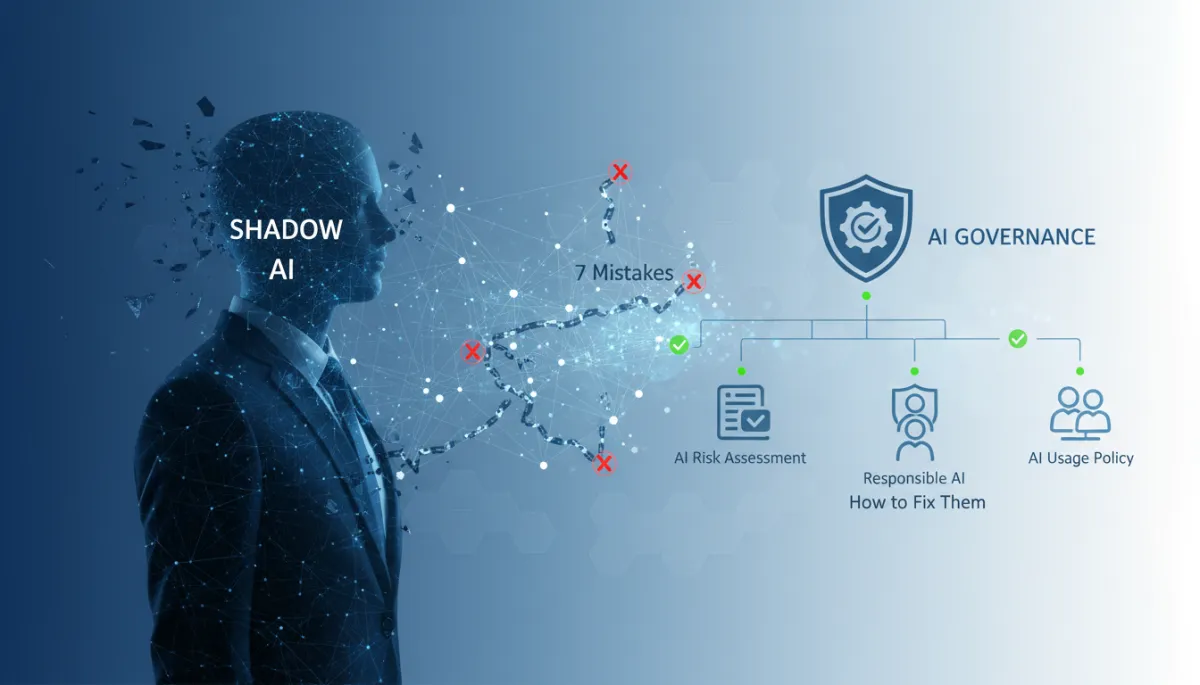
Avoid Shadow AI Mistakes: Governance Tips
AI Governance, Shadow AI, Business AI Strategies
7 Mistakes You’re Making with Shadow AI (and How to Fix Them)
Shadow AI is exploding across businesses and agencies. From marketers quietly using chatbots to draft campaigns, to analysts feeding client data into online tools, AI is being adopted faster than your policies can keep up. While this innovation can be a competitive advantage, unmanaged shadow AI is also a growing source of risk, from data leaks to compliance breaches. The good news: with the right AI governance, AI risk assessment, and clear AI usage policies, you can turn these shadow AI mistakes into powerful, responsible AI strategies.
What Is Shadow AI — and Why It Matters
Shadow AI refers to any use of artificial intelligence tools, models, or assistants that happens outside official oversight. It might be a designer using a generative tool with client assets, or an account manager pasting sensitive information into a public chatbot. These activities often start with good intentions—speed, creativity, better outcomes—but without AI governance and AI compliance guardrails, they can quietly introduce serious risk to your organization, clients, and brand.
Mistake 1: Treating Shadow AI as a Minor IT Problem
Many leaders still see shadow AI as a technical nuisance instead of a strategic issue. They assume IT will “lock things down” and the problem will disappear. In reality, this mindset ignores how deeply AI is already woven into everyday workflows across marketing, sales, operations, and client services. Shadow AI is not just about tools; it is about behavior, incentives, and culture.
💡 Pro Tip: Treat shadow AI as a cross-functional challenge that involves leadership, IT, legal, HR, and business unit heads—not just your tech team.
How to Fix It
Establish an AI governance committee or working group that includes business, agency, and compliance leaders.
Make AI a standing item in leadership meetings, tied to business AI strategies and client outcomes, not just technology updates.
Mistake 2: Having No Clear AI Usage Policy
If your teams are using AI tools without guidelines, they are improvising the rules as they go. That leads to inconsistent decisions about what data can be shared, which tools are safe, and how AI-generated outputs are reviewed. This is one of the most common shadow AI mistakes: assuming “common sense” is enough. It is not—especially when sensitive client information, intellectual property, and regulatory obligations are on the line.
How to Fix It
Draft a concise, plain-language AI usage policy that covers what tools are approved, what data is allowed, and required human review steps.
Include examples tailored to your business or agency scenarios: campaign creation, client reporting, proposal writing, data analysis, and internal communications.
Make the policy easy to find and part of onboarding, not hidden in a legal folder no one reads.
Mistake 3: Ignoring AI Risk Assessment Until Something Breaks
Many organizations only think seriously about AI risk assessment after a scare: a data leak, a client complaint, or an uncomfortable question from a regulator. By then, it is damage control. Shadow AI amplifies this risk because you cannot protect what you do not know exists. Unvetted tools may store data in unknown jurisdictions, reuse prompts to train models, or expose confidential information through integrations you did not approve.

Proactive AI risk assessments reduce surprises and strengthen client and regulator trust.
How to Fix It
Conduct an AI inventory: survey teams about every AI tool, plugin, and workflow they use, including free and experimental tools.
For each use case, perform an AI risk assessment that considers data sensitivity, model transparency, vendor practices, and potential business impact.
Prioritize remediation for high-risk scenarios, such as client data in public tools or automated decisions that affect people’s rights or finances.
Mistake 4: Overlooking Responsible AI Principles
Shadow AI often bypasses the checks you would normally apply to new technology. That means issues like bias, fairness, explainability, and transparency may never be considered. For agencies and businesses working with diverse audiences or regulated industries, this is risky. Outputs could unintentionally reinforce stereotypes, misrepresent data, or mislead stakeholders—undermining your commitment to responsible AI and ethical practice.
How to Fix It
Create simple responsible AI guidelines: fairness, transparency, human oversight, and respect for privacy and intellectual property.
Require teams to review AI outputs for bias, accuracy, and tone—especially for external content, client deliverables, and hiring or performance-related uses.
Offer quick training sessions that show real examples of biased or misleading AI outputs and how to correct them.
Mistake 5: Underestimating AI Compliance Obligations
Regulations around AI, data protection, and consumer rights are tightening worldwide. Even if you are not directly in a highly regulated sector, your clients might be. Shadow AI can easily conflict with requirements like data minimization, consent, auditability, and sector-specific rules. When employees use unapproved tools, you lose visibility into how data is processed and stored, making AI compliance extremely difficult to demonstrate.
How to Fix It
Map your AI use cases against existing regulations (such as privacy, advertising, financial, or healthcare rules) and emerging AI-specific frameworks.
Work with legal and compliance teams to define approved AI vendors and configurations that meet your contractual and regulatory obligations.
Build documentation habits: record which models, prompts, and review steps were used for high-stakes decisions or client work.
Mistake 6: Focusing Only on Blocking Tools Instead of Enabling Safe Use
Some organizations respond to shadow AI by trying to block every AI site and plugin. This often backfires. Teams still find workarounds, or they lose productivity and creativity compared to competitors and other agencies. A purely restrictive approach pushes AI use further into the shadows instead of bringing it into a governed environment. The result: more risk, not less.
How to Fix It
Provide secure, approved AI options—such as enterprise-grade chat tools or integrated AI features in your existing platforms—that align with your AI governance framework.
Encourage teams to propose new AI use cases, then evaluate them through your AI risk assessment process instead of rejecting them by default.
Communicate clearly: the goal is not to stop AI, but to use it safely, ethically, and strategically.
Mistake 7: Lacking a Coherent Business AI Strategy
When AI adoption is ad hoc, every team experiments in isolation. Some win, some waste time, and nobody shares what works. Shadow AI thrives in this vacuum. Without a clear vision for how AI supports your goals—whether that is campaign performance, client satisfaction, operational efficiency, or new services—you cannot prioritize investments or measure impact. You end up with scattered tools instead of a competitive advantage.
How to Fix It
Define a small set of business AI strategies linked directly to revenue, cost savings, client value, or innovation—for example, “accelerate content production while maintaining brand safety” or “enhance analytics insights for clients.”
Align AI governance, AI usage policy, and AI compliance efforts around these priorities, so guardrails support your strategy instead of slowing it down.
Track outcomes: time saved, quality improvements, client feedback, and risk incidents avoided. Use this data to refine your approach.
Bringing Shadow AI Into the Light
Shadow AI is not going away. Your people will continue to reach for the tools that help them move faster and deliver more value. The question is whether that happens in secret—or within a framework of responsible AI, clear AI usage policies, and robust AI governance that protects both your organization and your clients. By addressing these seven shadow AI mistakes head-on, you can move from reactive firefighting to proactive strategy.
For businesses and agencies, the opportunity is significant: safer experimentation, more consistent compliance, and AI-driven services that differentiate you in a crowded market. Start with visibility—discover where AI is already in use. Then put in place the policies, risk assessments, and training that turn scattered experimentation into a disciplined, innovative AI program. When you bring shadow AI into the light, you do not just reduce risk—you unlock a smarter, more resilient future for your organization.
